Speed
Development moves much faster than regulation, infrastructure planning, and upgrades. A site can seek service before the grid or permitting process is ready to accommodate it.
Technology policy / Electricity / Water / Communities
Regulatory challenges, technical constraints,
and policy responses across states.
How can states turn growing digital infrastructure into a public asset while accounting for the costs borne by its neighbors?
01 / Challenges & opportunities
Datacenters combine dense computing equipment with power conversion, backup generation, and cooling. Their growth creates demands on electricity and water systems that outlast any single generation of hardware.
Development moves much faster than regulation, infrastructure planning, and upgrades. A site can seek service before the grid or permitting process is ready to accommodate it.
The number of proposed sites and their sizes continually change the landscape. Utilities must plan for large additions while distinguishing credible demand from proposals that may never materialize.
Buildings endure, but compute, power, and cooling hardware change. A facility’s energy demand, load shape, or cooling requirements can evolve within the same physical footprint.
Power, water, land use, emissions, and community effects demand decisions across different policy areas. A choice that eases one constraint can increase pressure on another.
Shift suitable computing tasks across time and locations to ease grid constraints through demand response and make better use of available clean power. The useful amount depends on the workload and service commitments.
Onsite generation and energy storage can reduce demand on the grid or become grid assets. Coordination and environmental limits determine whether those resources can help during a system emergency.
Choose locations that work for both the operator and the community. Electricity availability, water conditions, and local impacts can enter the decision before a project creates long-term commitments.
Fund new clean generation, grid upgrades, water infrastructure, and community benefits through specific, long-term commitments. The terms determine which costs the project carries.
Operators have unusual control over where and when they compute, and how they power and cool it.
Why the physical constraints matter
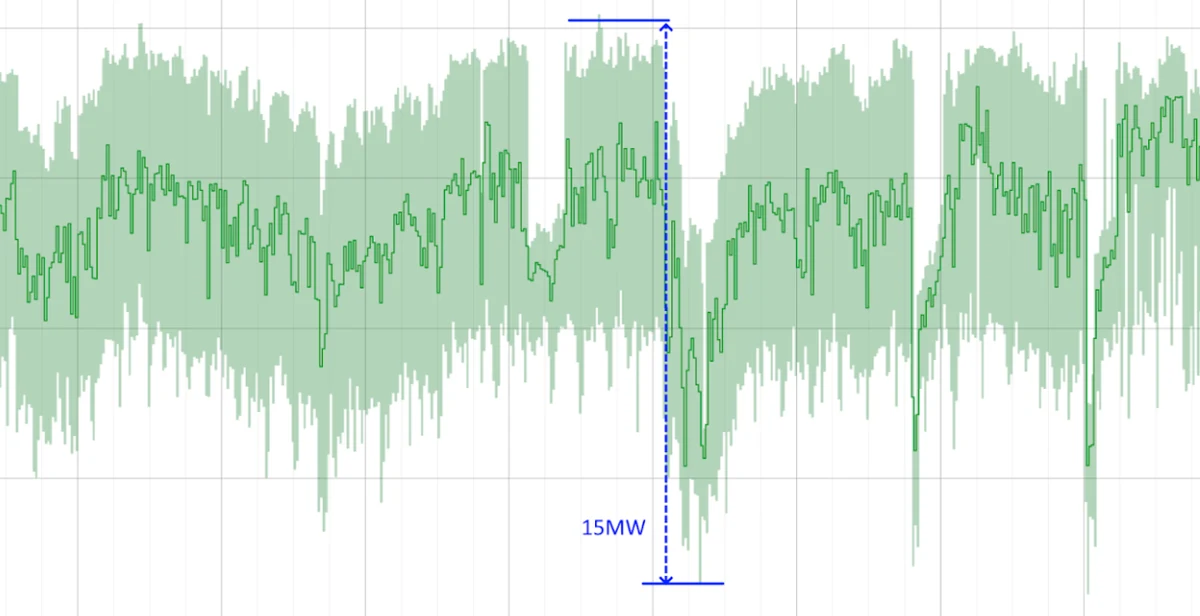
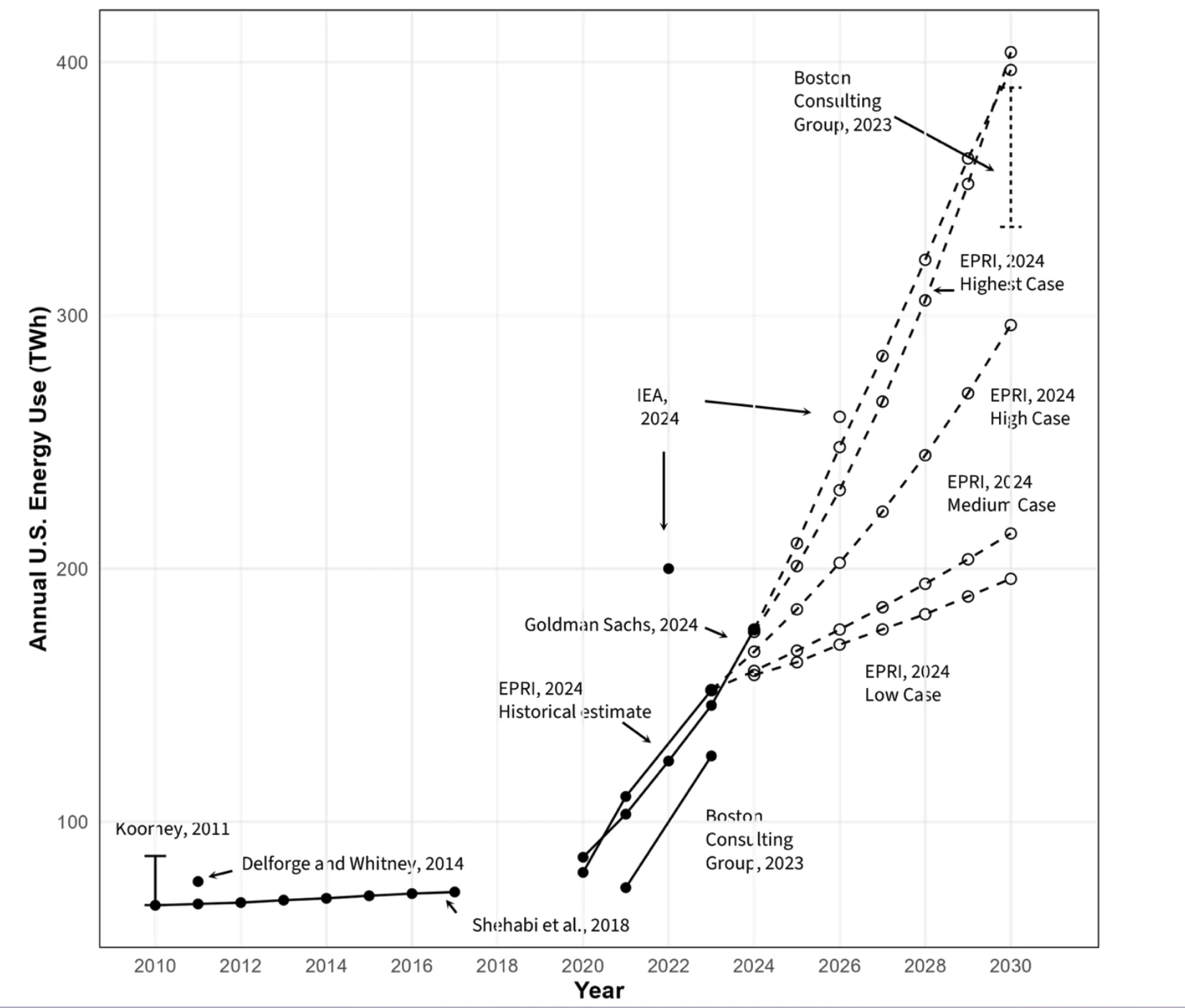
Datacenter growth requires expansion of power generation and delivery capacity. Large, fast changes in AI workload demand also pose an operational problem for grid stability.
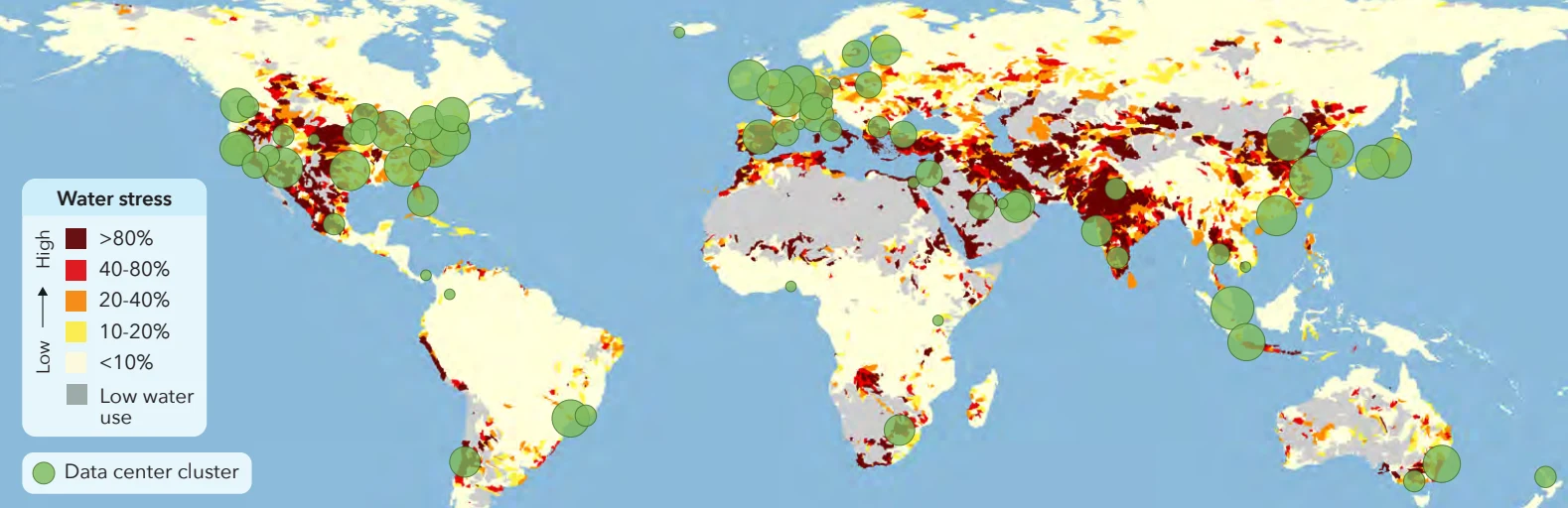
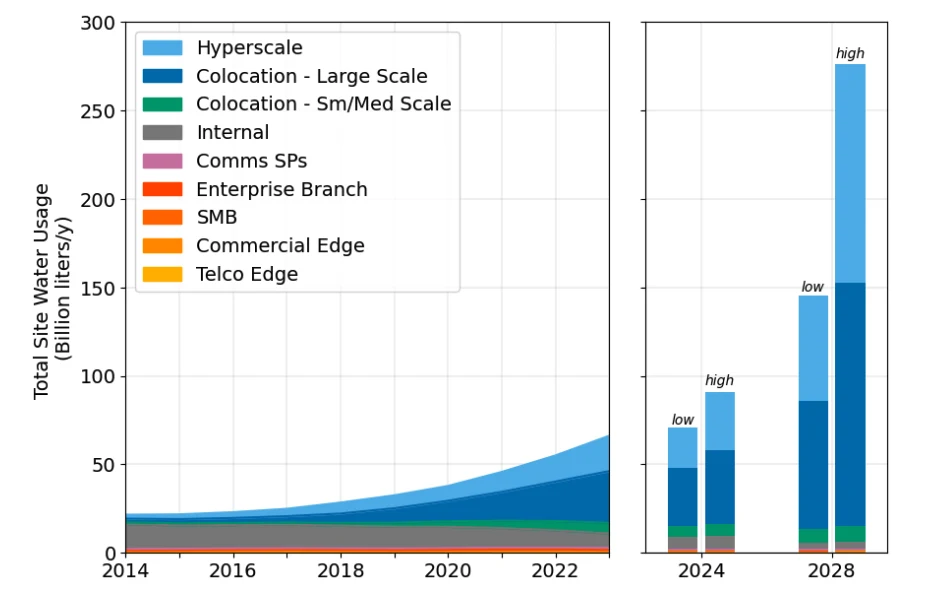
Cooling links electricity and water. Water-saving choices can increase electric demand, while water-intensive cooling can place pressure on an already stressed basin. Regulation needs both the scale of consumption and the local context.
02 / Scope & method
The study focuses on state-level legislation because states have broad control over utilities, resources, and tax incentives, and can offer transferable regulatory models.
Land use, local water, noise, property taxes, and community impacts.
Utility regulation and costs, water policy, and incentives. These tools connect project decisions to system-wide obligations.
Transmission, wholesale markets, environmental rules, and reliability requirements.
The cases examine concrete regulatory mechanisms for datacenter integration. Local decisions remain important, but their site-specific character makes them harder to transfer directly across jurisdictions.
Follow the cases in order, or choose a criterion to go directly to its example.
Facility scope and the principal demand triggers that bring a project into the regime.
Readiness screening, studies, queues, load forecasting, planning, and reliability conditions.
Defined ability to shift or reduce demand, respond to emergencies, and measure delivery.
Responsibility for upgrades and stranded assets, and the information that makes it verifiable.
Clean capacity, efficiency and sustainable design, and controls on onsite emissions.
Supply review, permits, cooling, conservation, reuse, reporting, and authority to limit use.
How binding obligations become operating procedures, enforcement, and measured outcomes.
The cases and qualitative assessments reflect the study’s policy snapshot. They compare policy design; they do not establish measured outcomes or a current legal compliance test.
03 / State case studies
Definitions establish coverage. Service conditions assign obligations. Implementation determines whether those obligations work. The examples below follow that sequence.
C1 / Definition · South Dakota
The first policy decision is who counts as a datacenter. The study compares principal electric-demand triggers ranging from 10 MW in South Dakota to 100 MW in Minnesota.
An illustrative 20 MW facility sits within South Dakota’s definition. That same size falls below the other principal thresholds shown in the comparison. The threshold therefore shapes how much of the sector a regulatory framework reaches.
Assumes the selected MW draw is sustained continuously. Uses 10,791 kWh per residential customer per year (about 1.23 kW on average), from EIA’s 2022 U.S. average. This compares average demand, not household peak demand.
These are the principal triggers compared in the study, not every provision. Definitions and boundary conditions differ; Virginia has separate provisions reaching smaller facilities. The slider compares sizes, not legal coverage.
C2 / Grid & interconnection · Texas
A proposed load can lead a utility to plan transmission and other infrastructure long before it consumes electricity. If several speculative requests describe alternative versions of the same project, planning can overstate the demand that will actually arrive.
SB 6 links the request for service to evidence and financial commitments. Its readiness screen brings four pieces of information into the interconnection process.
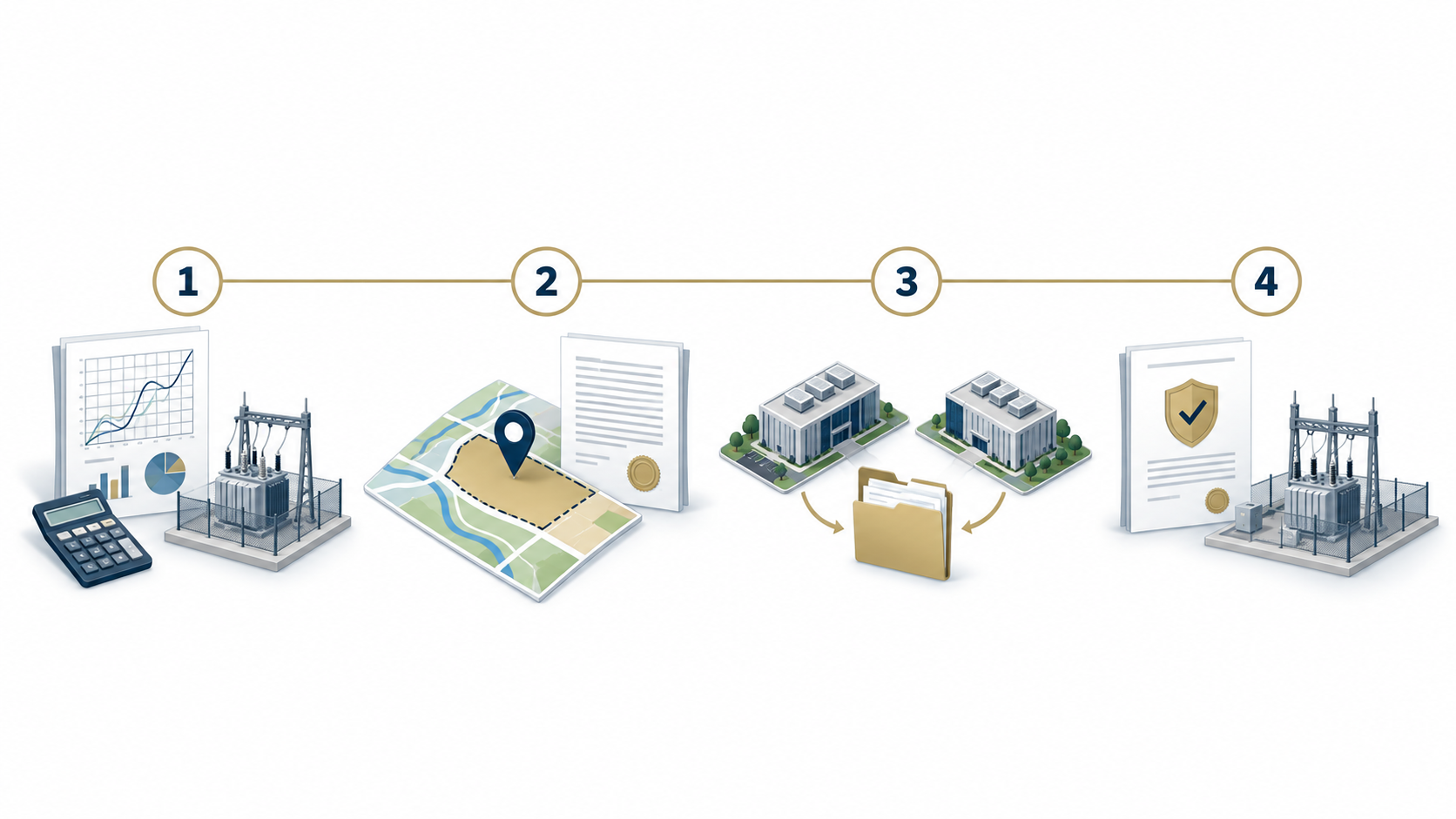
Funds initial transmission screening for covered large loads.
Ownership, a lease, or another accepted legal interest supports the proposed location.
Reveals substantially similar in-state service requests when an alternative approval could materially change, delay, or withdraw this request.
Requires backing for the transmission infrastructure needed to serve the load.
Credible projects reduce the risk of stranded grid investments.
The screen supports planning; it does not guarantee a project will proceed. Detailed interconnection procedures and implementation rules still matter.
C3 / Flexibility · Texas & Virginia
Datacenters may be able to shift work, reduce grid demand, or use backup power. The regulatory distinction is who can call on that capability, under what conditions, and with what limits.
In Texas, the sequence matters: the relevant market services must be deployed before the emergency direction described in SB 6, subject to the statute’s exception for frequency-responsive services. The mechanism concerns qualifying backup resources and does not authorize an emissions violation.
“Flexible” needs an operational meaning: a response, an authority, and conditions for delivery.
C4 / Costs & transparency · South Dakota
New infrastructure can remain in place after a datacenter closes, leaves, or reduces its electricity use. A consumer-protection framework must address that possibility when service begins.
South Dakota requires separate terms and conditions for electricity service to datacenters. The law provides for recovery of costs fairly attributable to serving the facility, including costs incurred if it departs the system or materially reduces its load.
Set separate service terms and identify attributable costs.
Assign recovery of the costs created by the datacenter.
Retain responsibility for the attributable costs that remain.
Transparency makes the allocation verifiable. The state’s wider approach includes public water reporting and preserves local authority, connecting the utility agreement to resource use and community oversight.
Specify both who bears the risk and what information makes that responsibility verifiable.
C5 / Clean energy · Minnesota
Minnesota uses service arrangements and incentive conditions to influence energy choices. They create different obligations, so participation, requirements, and consequences need to remain distinct.
A voluntary tariff and a condition attached to tax benefits give the state different ways to influence energy choices.
The tariff is optional. The certification requirement applies to qualifying incentive recipients; it is not presented here as a universal requirement for every facility.
C6 / Water · Minnesota
A cooling design commits a facility to a particular relationship with electricity and water. Minnesota’s special review connects that choice to the availability of the resource before a permit decision.
The trigger has both conditions. Once it applies, the review considers the supply, the cooling approach, and the effects on others.
Evaluate whether the source can support the proposed consumptive demand.
Examine the cooling choices and opportunities to conserve or reuse water.
Consider the consequences for competing users and the surrounding environment.
The review joins a technical choice inside the datacenter to a resource decision outside it.
Consumptive use is the relevant quantity in this trigger. It should not be silently substituted with total water withdrawals.
C7 / Implementation · Texas & New York
Enactment establishes authority and obligations. Operational completeness depends on the procedures and institutions that make those obligations work.
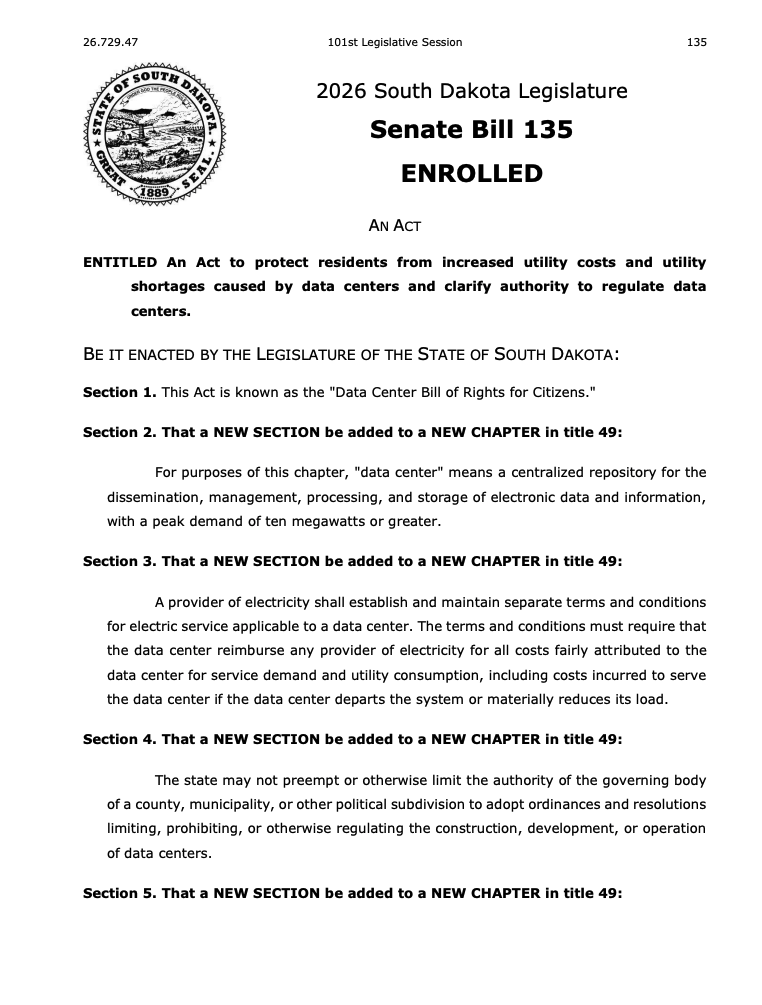
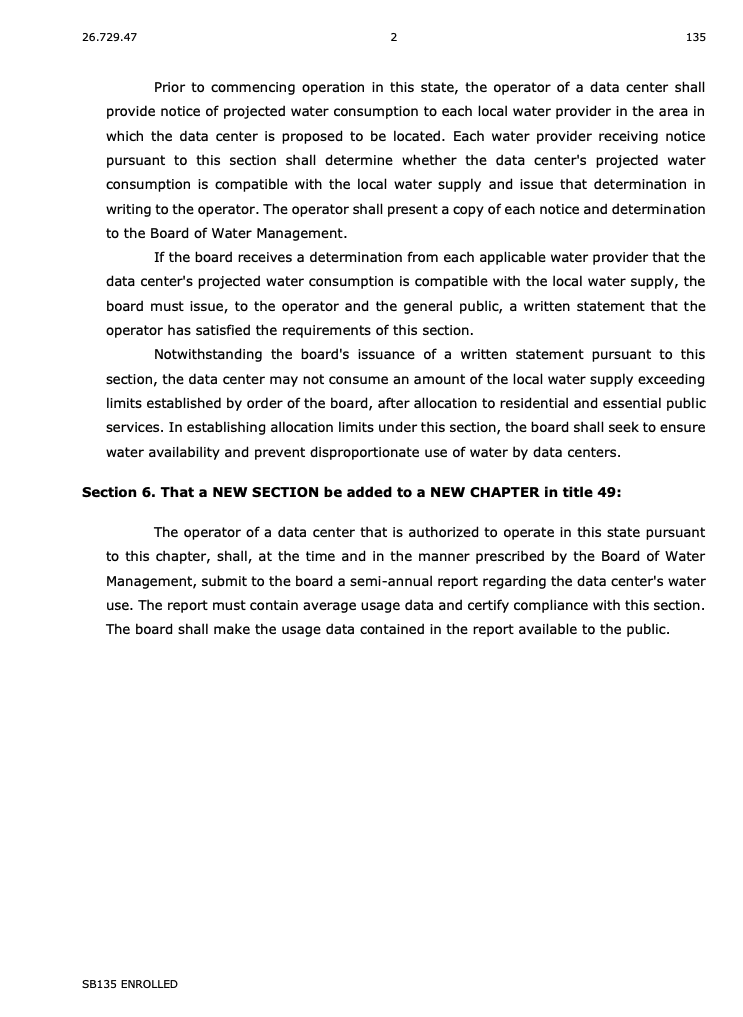
Why this belongs under implementation. The short statute leaves substantial work for administration: translating “fairly attributed” costs into service terms, determining how a water provider establishes compatibility, setting allocation limits after residential and essential public services, and specifying the timing and manner of semiannual reporting. The compact law makes the distance between a broad obligation and its day-to-day rules visible.
Grid-screening and emergency duties.
Interconnection procedures and reliability-service design.
Temporary restraint on covered permits.
Permanent environmental and operating standards.
Texas illustrates the distance between a statute and a fully specified service or interconnection process. New York offers a contrasting precautionary approach, creating a period for review while permanent standards develop.
New York’s restraint concerns covered environmental permits, with exclusions. It is not a blanket ban on all datacenters. The comparison retains the study’s interim assessment.
Legal implementation and measured policy outcomes remain to be determined.
Across the cases
The comparison brings the examples back together. Texas emphasizes grid integration and flexibility; Minnesota links energy and water decisions; South Dakota focuses on protection and disclosure. Virginia combines several resource tools, while New York’s community review remains an interim model.
| Dimension | Texas | Minnesota | South Dakota | New York | Virginia |
|---|
Community review is a cross-cutting row in the study’s comparison, distinct from the seven numbered case criteria. New York’s “Leading / interim” assessment is provisional.
04 / Highways & datacenters
The interstate highway system connected the twentieth-century economy. Datacenters serve as infrastructure for AI, security, and global digital trade in the twenty-first. Both connect a national purpose to costs concentrated in the communities that host them.
Physical connectivity
The twentieth-century model for national growth enabled commerce and security through an interconnected transportation system.
Digital connectivity
The twenty-first-century network supports AI, security, and a global digital economy through interconnected computing infrastructure.
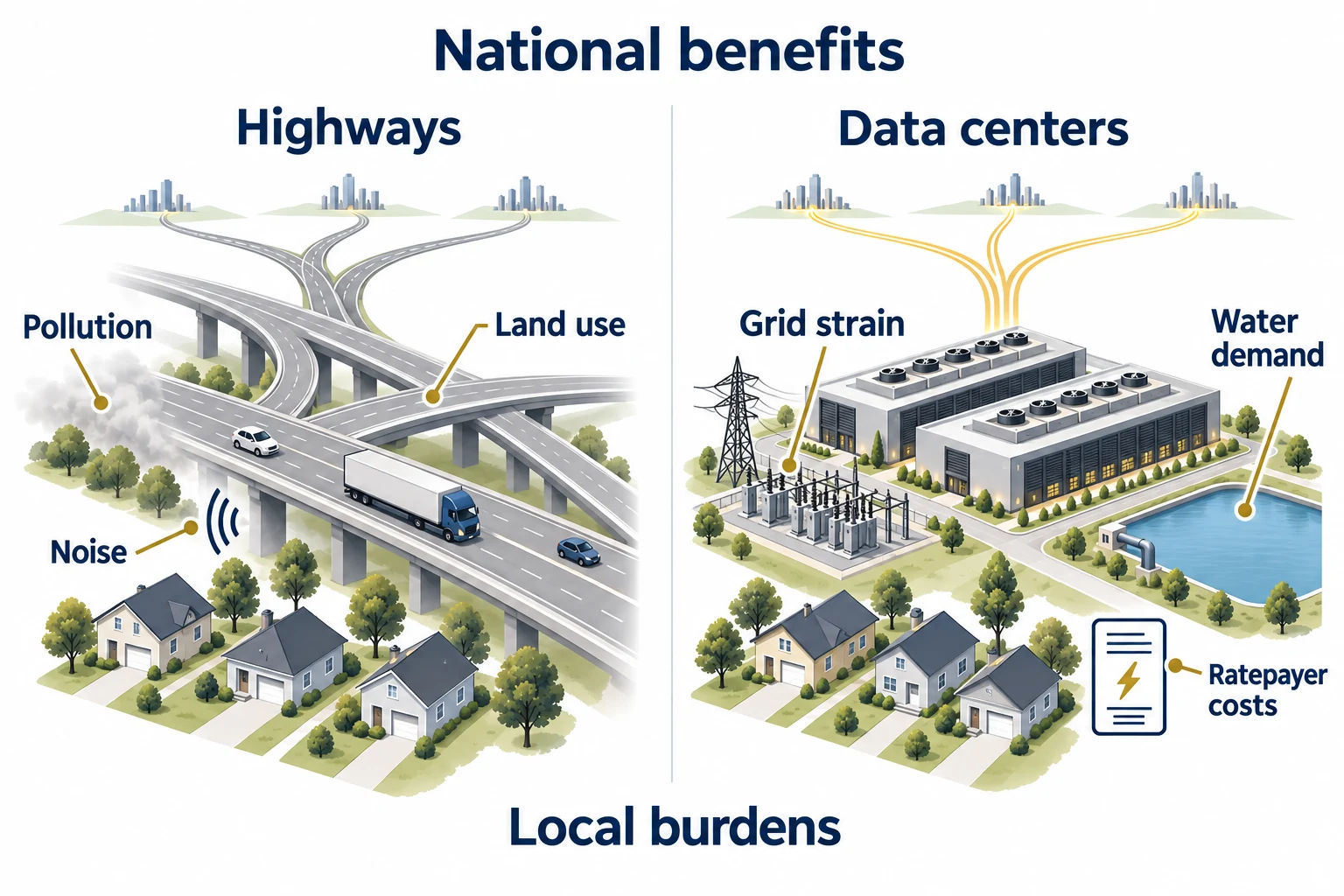
National infrastructure ambitions need specific commitments to the places that make them possible.
The state examples show how those commitments can take shape: credible projects, defined flexibility, attributable costs, clean-energy arrangements, water review, and implementation that can be evaluated.